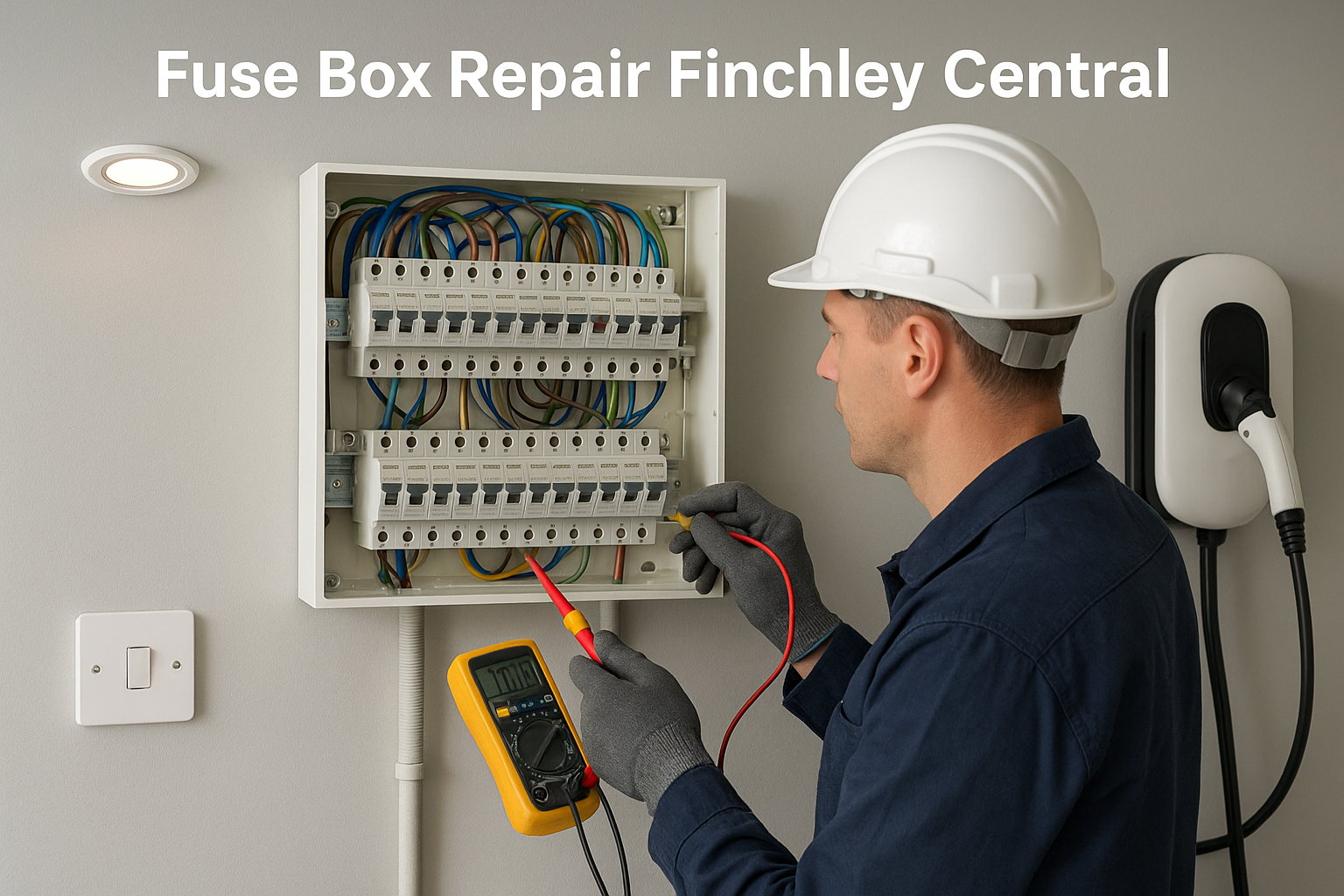
If your fuse box keeps tripping, a breaker will not reset, or you have a buzzing or hot fuse board, you need a local electrician who can find the fault safely and explain what is happening in plain English. ElectriCity Services provides fuse box repair in Finchley Central for homeowners, landlords, tenants and property managers across the area, including homes near Finchley Central Station, Ballards Lane, Regents Park Road, Victoria Park and Church End.
Fuse box problems are often a sign of an underlying electrical fault rather than a simple inconvenience. It might be a damaged appliance, a loose connection, moisture, overload, ageing wiring, a failing breaker or an old fuse wire board that no longer gives reliable protection. The right approach is careful fault finding, testing and repair, not guesswork. That is especially important in Finchley Central, where you will find a mix of Victorian terraces, converted flats, older rewires, modern flats, shops and offices, all with different electrical demands and different levels of wear.
ElectriCity Services works across the local area from 10A Ballards Ln, London N3 2HA and is available 24 hours for urgent electrical help. If you need fuse box fault finding in Finchley Central, tripping breaker investigation in Finchley Central, RCD nuisance tripping in Finchley Central, faulty breaker replacement in Finchley Central or fuse board safety checks in Finchley Central, call 020 3633 1608 or email info@finchleycentralelectricians.co.uk.
We focus on the practical job in front of us: identify the cause, isolate the affected circuit, explain the options and carry out the repair or recommend the safest next step. Where a repair touches on consumer unit work or other notifiable electrical work, it should be handled and certified appropriately by a competent electrician.
Fuse Box Fault Finding in Finchley Central
Fuse box fault finding is the starting point when the problem is not obvious. A fuse box or consumer unit can show symptoms long before a full failure, and the cause is not always inside the board itself. In Finchley Central properties, we often see issues linked to kitchen appliances, old lighting circuits, garden power, storage heaters, shower circuits, or older installations that have been altered over time.
Common signs include a fuse box that keeps tripping, a breaker that will not reset, loss of power to part of the property, flickering lights, burnt smells near the board, or a board that feels warm to the touch. In older homes around Church End and near Ballards Lane, we also come across fuse wire boards and mixed-age installations where previous repairs have been pieced together over time. In those cases, the first task is to establish whether the fault is on one circuit, one appliance, or the board itself.
Our fault finding process is designed to reduce disruption while getting to the root cause. That can include visual inspection, safe isolation, circuit testing, checking loads, identifying signs of heat damage, and tracing whether the issue is being caused by a fixed appliance, a socket circuit, lighting circuit or the consumer unit. If the fault is intermittent, we look for patterns: when it happens, which rooms are affected, and whether it follows use of a particular item such as an oven, kettle, washing machine or heater.
For landlords and property managers, accurate fault finding matters because it helps separate a one-off appliance issue from a wider electrical concern. For tenants and homeowners, it means you get a clear explanation instead of repeated resets that only mask the problem.
Tripping Breaker Investigation in Finchley Central
A tripping breaker is the system doing its job, but repeated tripping means something is wrong and needs checking. If your breaker trips as soon as you switch it back on, or trips when you use a certain appliance or room, the cause could be overload, a short circuit, a damaged cable, a loose connection or a failing breaker.
In Finchley Central, tripping breaker investigation often starts with the property layout. Older Victorian terraces may have had several upgrades over the years, while converted flats can have shared routes, altered circuits or limited consumer unit space. Modern flats may have higher appliance loads, especially where electric cooking, laundry equipment and home office kit are all running at once. Shops and offices near Regents Park Road and surrounding streets may also see breaker trips caused by equipment start-up loads or overloaded power strips.
We look at the sequence of events carefully. Did the breaker trip when a heater came on? Did it happen after a new appliance was plugged in? Does it only occur in wet weather or after a room has been unused for a while? These clues help narrow the issue before any repair is carried out. Once we identify the likely cause, we can advise whether the circuit needs repair, the breaker needs replacement, or the load on that circuit needs to be reduced.
If the breaker will not reset, do not keep forcing it. Switch off connected appliances where safe, keep clear of any damaged sockets, and arrange a visit. Repeated resetting can make the fault harder to trace and may increase the risk of further damage.
RCD Nuisance Tripping in Finchley Central
RCD nuisance tripping is common in homes and commercial premises, but it should never be ignored. An RCD is designed to disconnect power when it detects an imbalance, which can indicate a dangerous fault. Sometimes the cause is straightforward, such as a faulty appliance, damp in an external socket, or a worn cable. Other times it is related to cumulative leakage from several items on the same circuit.
In Finchley Central homes, RCD issues are often reported in kitchens, bathrooms, utility rooms and outdoor circuits. We also see them in older rewires where modern appliances are connected to circuits that were not originally designed for today’s electrical demand. In flats, nuisance tripping can happen when several devices are used at once, especially if one appliance has a developing fault that is not immediately obvious.
Our approach is to test the circuit rather than simply replacing parts without evidence. That may involve checking the RCD operation, looking for earth leakage, reviewing connected equipment, and isolating circuits one by one to see where the imbalance is coming from. If a fixed appliance is the source, we will explain that clearly so you can decide whether the appliance should be repaired or replaced by the relevant specialist.
It is worth remembering that not every trip is nuisance tripping. Sometimes the RCD is warning you about a real fault. If you smell burning, see scorch marks, or hear crackling from the fuse board or a socket, switch off the affected circuit at the consumer unit if it is safe to do so and arrange urgent help.
Faulty Breaker Replacement in Finchley Central
Sometimes the issue is not the wiring or the appliance but the breaker itself. A faulty breaker can trip too easily, fail to reset properly, or no longer provide reliable protection. In those cases, replacement may be the correct remedy, but only after the circuit has been checked and the underlying cause ruled out.
Breaker replacement in Finchley Central is often part of a wider repair when a consumer unit has aged, suffered heat damage, or been modified over time. In older properties, particularly around Church End and the streets leading towards East Finchley, we often find a mix of old and newer components that need careful assessment before any part is changed. In modern flats and commercial units, the issue may be more specific, such as a breaker that has reached the end of its serviceable life or one that no longer matches the demands placed on the circuit.
We do not recommend replacing a breaker just to stop it tripping. A breaker is there to protect the circuit, so if it is operating because of a fault, the fault must be identified first. Once testing shows that replacement is appropriate, we can advise on the correct component and whether any associated consumer unit work should be considered at the same time.
If you are a landlord or property manager, breaker replacement can also be a good opportunity to review the wider condition of the board, labels, circuit protection and accessibility, especially where occupants have reported repeated faults.
Fuse Board Safety Checks in Finchley Central
Fuse board safety checks are sensible whenever there has been a trip, a burning smell, signs of heat, an old installation, or a recent change in how the property is used. They are also useful before letting a property, after a refurbishment, or when a home has a board that has not been reviewed for some time.
In Finchley Central, safety checks are particularly relevant in Victorian terraces, converted flats and older rewires where the consumer unit may not reflect current usage. We also see concerns in shops and offices where equipment has been added gradually and the original distribution board has never been properly reviewed. A safety check can highlight issues such as loose terminations, damaged accessories, outdated protection, overloaded circuits, poor labelling, signs of overheating and evidence of previous makeshift repairs.
Our checks are carried out with the aim of helping you understand the condition of the board and the likely next steps. If the fuse board is safe but needs maintenance, we will say so. If there are signs that the installation needs further work, we will explain what that means in practical terms and whether it is likely to involve consumer unit work, circuit repairs or further investigation.
For property managers and landlords, this kind of assessment helps plan repairs responsibly and reduces the risk of repeat callouts. For homeowners and tenants, it provides peace of mind that the board has been looked at properly rather than just reset after a trip.
We also support related electrical work across Finchley Central, including electrician callouts, emergency electrician visits, electrical repairs, consumer unit work, lighting installation, socket installation, electrical fault finding and domestic electrician services. In some properties, a fuse box issue is only one part of a wider electrical problem, so it helps to have one local team that can inspect the fault and advise on the next step.
Recent local work has included a kitchen wiring inspection in East Finchley after nuisance tripping, a replacement light fitting support visit in Church End, and an intermittent lighting fault repair in Mill Hill. That kind of day-to-day work gives a good picture of the electrical issues local properties face: mixed-age wiring, changing appliance loads, and faults that only show themselves under normal use.
If your fuse box is giving you trouble in Finchley Central, do not keep resetting it and hoping it will clear. Switch off any visibly faulty equipment if it is safe, keep away from damaged wiring or a hot board, and book a proper inspection. Call ElectriCity Services on 020 3633 1608 for fuse box repair in Finchley Central, or email info@finchleycentralelectricians.co.uk to request a visit. You can also find us at 10A Ballards Ln, London N3 2HA, close to Finchley Central Station and the local routes serving North Finchley, East Finchley, Church End, Mill Hill and Hendon.
Before any electrical work is booked, customers should ask for current scheme registration and insurance details where relevant. For safety-critical faults, the priority is always proper testing, clear advice and a repair carried out with the right competence for the job.