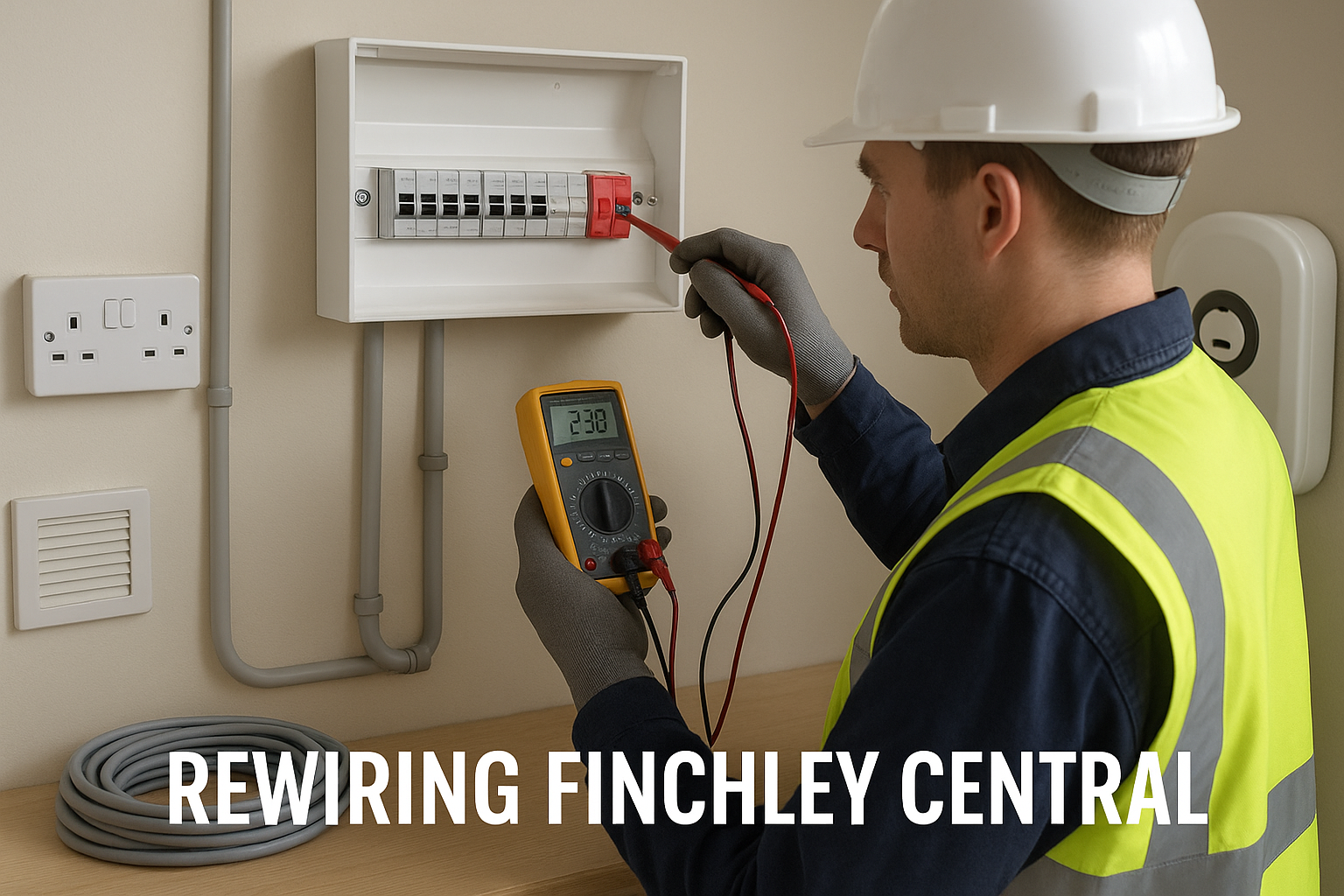
If you need rewiring Finchley Central, the safest approach is to start with the condition of the existing wiring, the age of the property and the problems you are seeing now. Rewiring is often needed where old rubber or fabric cabling has deteriorated, where there is no effective earthing, where faults keep returning, or where a property has failed an inspection and the electrical installation needs bringing up to a safer standard.
At ElectriCity Services, we support homeowners, landlords, property managers and builders across Finchley Central from our base at 10A Ballards Ln, London N3 2HA. We work on Victorian terraces, converted flats, older rewires, modern flats, shops and offices, and we regularly help customers who want clear advice before committing to a full or partial rewire. If you are near Finchley Central Station, along Ballards Lane, by Victoria Park, around Church End or on Regents Park Road, we can assess what is needed and explain the practical options.
For many properties, rewiring is not just about replacing cables. It is also about improving the layout of the circuits, reducing repeat callouts, making future maintenance easier and ensuring the installation is suitable for modern appliances, lighting and socket use. If you have nuisance tripping, unreliable lighting, sockets that run hot, or wiring that has become difficult to trust, it is sensible to arrange an inspection rather than waiting for a complete failure.
Call 020 3633 1608 or email info@finchleycentralelectricians.co.uk to request a visit today.
Full House Rewiring in Finchley Central
A full house rewire is usually the right option when the existing wiring has reached the end of its useful life, when multiple circuits are failing, or when a property needs a more substantial electrical upgrade. In Finchley Central, this often applies to older homes with original or partially updated wiring, especially where old rubber or fabric cabling is still present or where there is evidence of previous patch repairs that have not solved the underlying issue.
From a maintenance point of view, a full rewire can reduce repeat callouts because it replaces ageing cables, worn accessories and outdated circuit arrangements in one planned project. It also gives a clearer starting point for future inspections and helps identify any related equipment issues such as an old consumer unit, poor lighting circuit layout or sockets that have been added over time without a consistent design.
Typical signs that a full rewire may be worth discussing include:
- frequent faults or repeated tripping
- burning smells, heat damage or discoloured accessories
- no earthing or inadequate earthing arrangements
- old rubber or fabric cabling visible in lofts, cupboards or behind fittings
- multiple extensions or alterations made over many years
- an electrical inspection that has highlighted serious remedial work
We also consider how the property is used. A family home with high appliance demand, a rented flat with regular tenant turnover, or a small office near Ballards Lane may all need different circuit planning and equipment placement. That is why a proper inspection comes before any recommendation on scope.
Some rewiring work may be notifiable under Part P of the Building Regulations depending on the extent of the work and the property arrangement. Customers should ask for current scheme registration and certification details before electrical work is booked.
Partial and Room Rewiring in Finchley Central
A partial or room rewire is often suitable where only part of the installation is causing problems, or where a renovation means one area needs to be upgraded without disturbing the whole property. This is common in Finchley Central homes where a kitchen, bedroom, loft room or extension has been altered while the rest of the property still has serviceable wiring.
Partial rewiring can help reduce repeat callouts by dealing with the circuit or room that is causing the most disruption. For example, if one room has frequent lighting faults, damaged sockets or unsafe cable routes, replacing just that section may be the most practical solution. In other cases, a single room rewire may form part of a planned decoration project or a landlord repair programme.
We often see partial rewiring requests linked to:
- faults after DIY alterations or previous poor repairs
- additional sockets needed for modern equipment
- older lighting circuits that no longer suit the room layout
- damage found during refurbishment
- issues identified during an inspection or property handover
Where possible, we explain whether a partial rewire is a short-term fix or a sensible stage in a wider upgrade plan. That matters for landlords and property managers in particular, because the aim is not only to get the power back on but also to avoid avoidable repeat visits.
If the affected area is part of a larger installation, we will also look at the condition of the associated circuits, consumer unit and equipment so the repair is not isolated from the rest of the system.
Period Property Rewiring in Finchley Central
Period properties in Finchley Central often need a careful approach because the wiring may have been altered several times, hidden behind later finishes or extended in stages. Victorian terraces and older converted buildings can contain a mix of wiring ages, with newer accessories alongside much older cabling. In these homes, the main concern is not simply age, but how well the different parts of the installation work together.
Period property rewiring usually starts with inspection and testing to identify unsafe sections, hidden deterioration and any lack of earthing or bonding. Old rubber or fabric cabling is a common issue in older homes, and it may be brittle, perished or no longer suitable for continued use. Where that is found, the safest long-term option is often replacement rather than repeated patch repairs.
We also take into account the fabric of the building. In period homes, cable routes, socket positions and lighting changes need to be planned with care so the electrical work supports the property rather than creating unnecessary damage. That is especially important where owners want to preserve original features while improving safety and reliability.
For landlords and property managers, period property rewiring can also help with inspection outcomes and reduce maintenance calls from tenants. A clearer circuit layout and properly tested equipment make future fault-finding more straightforward, which matters when several rooms or occupants are involved.
If you are unsure whether a full or partial rewire is the right route, the best next step is a professional assessment rather than guessing from visible symptoms alone. Problems in older properties often run deeper than the first fault seen at a socket or light fitting.
Rewiring During Renovation in Finchley Central
Renovation is one of the best times to tackle rewiring because access is usually better and the electrical layout can be designed around the new use of the space. In Finchley Central, we often help during kitchen upgrades, loft conversions, extensions, flat refurbishments and whole-house renovation projects where the existing wiring no longer matches the planned rooms or appliances.
Rewiring during renovation can prevent future disruption. If the walls, ceilings or floors are already open, it is usually more efficient to review the cabling, sockets, lighting points and circuit arrangement at the same time rather than returning later to correct avoidable issues. For builders and property managers, that can help keep the programme moving and reduce follow-on callouts after handover.
Common renovation-related issues include:
- new appliances requiring dedicated circuits
- relocated kitchen layouts
- additional lighting or switching requirements
- extension wiring that must integrate with the existing installation
- older circuits needing confirmation before redecoration
We can support the first fix and second fix stages of wiring in Finchley Central, working with the build sequence so the installation is ready for the next trade or the final fit-out. That is especially useful where the property is occupied part of the time and the work needs to be planned around access and safety.
For renovation work, it is also wise to think beyond the immediate project. A layout that works well today should also make future maintenance easier, with sensible circuit grouping and equipment placement that reduces the chance of unnecessary repeat visits.
First Fix and Second Fix Wiring in Finchley Central
First fix and second fix wiring are the two main stages of a rewire or larger electrical project. First fix is the stage where cables, back boxes and circuit routes are installed before plastering or finishing work. Second fix is the stage where sockets, switches, light fittings and final equipment are connected and tested.
In Finchley Central, this staged approach is useful for renovations, extensions and full rewires because it allows the electrical work to align with the building schedule. It also helps reduce repeat callouts later, as the installation can be planned properly from the start instead of being adapted room by room after the property is finished.
During first fix, we look at cable routes, circuit separation and the practical needs of the property. During second fix, we complete the visible equipment and check that the installation works as intended. This is also the stage where faults such as incorrect switch wiring, poor light fitting connections or socket issues can be identified before the job is signed off for normal use.
For domestic and commercial customers alike, good first fix and second fix planning makes future maintenance easier. A clear circuit structure means that if a problem does arise later, fault finding is quicker and less disruptive. That is especially valuable in homes with busy family routines, landlords managing multiple tenancies, and local businesses that need reliable lighting and power.
Our recent work has included a kitchen wiring inspection in East Finchley after nuisance tripping, support with a replacement light fitting in Church End, and tracing an intermittent lighting fault in Mill Hill. Those jobs show the kind of practical, problem-led electrical work that often sits behind a larger rewiring conversation: one fault may point to a wider issue in the installation.
Inspection, testing intervals and reducing repeat callouts
Maintenance-led rewiring starts with inspection and testing. If a property has recurring electrical issues, the safest course is to identify whether the problem is local to one circuit or part of a wider deterioration in the installation. That approach helps avoid repeated short-term fixes that never fully solve the cause.
For homeowners, landlords and property managers in Finchley Central, the right testing interval depends on the property type, use and condition. Older homes, rental properties, converted flats and premises with heavier use may need more regular attention than a straightforward modern flat. If a property has already shown faults, has had a failed inspection, or contains old wiring, it should be checked promptly rather than left until the next routine visit.
Inspection and testing can help identify:
- damaged or deteriorated cabling
- poor connections at accessories or fittings
- earthing and bonding concerns
- overloaded or poorly arranged circuits
- equipment that is no longer suitable for the installation
Reducing repeat callouts is often about more than replacing one failed part. It means tracing the underlying cause, checking the associated circuit and making sure the repair fits the wider installation. For example, a lighting fault may be linked to a switch line issue, a loose connection or a worn fitting rather than just the visible symptom. A socket problem may reflect age, load or cable condition elsewhere in the circuit.
If you notice heat, burning smells, flickering lights, persistent nuisance tripping or dead sockets, switch off the affected circuit at the consumer unit if it is safe to do so, keep clear of damaged wiring and arrange a qualified electrician. Do not attempt to open up wiring or make repairs yourself.
Local electrical support across Finchley Central and nearby areas
ElectriCity Services works across Finchley Central and nearby locations including North Finchley, East Finchley, Church End, Mill Hill and Hendon. We also support properties close to Finchley Central Station, Ballards Lane, Victoria Park, Church End and Regents Park Road. That local focus helps when customers need practical advice about access, property age, likely wiring routes and the type of electrical work best suited to the building.
Alongside rewiring, we also provide related domestic and commercial electrical services including electrician callouts, emergency electrician support, electrical repairs, consumer unit work, lighting installation, socket installation, electrical fault finding and domestic electrician services. If the issue turns out not to be a full rewire, we can still help with the fault, repair or upgrade that will restore safer use and reduce future disruption.
We also use supplied proof links so customers can check our business presence online: Google Business Profile and 192.com listing.
If you are planning a rewire, want a second opinion after an inspection, or need help reducing repeat electrical problems, call 020 3633 1608 today or email info@finchleycentralelectricians.co.uk. We are open 24 hours and ready to discuss the safest next step for your property.